
PAR-2 Technology

Protease-Activated Receptor-2 (PAR-2)

We are developing a novel class of small molecules that inhibit Protease-activated Receptor-2 (PAR-2), a receptor found in neurons, airway and immune cells, that generates cellular signals involved in inflammation and pain. Our first-in-class small molecules have the potential to fill an unmet need for treating airway inflammation and chronic pain, with reduced adverse effects, by targeting a receptor that directly promotes both conditions.

How does PAR-2 work therapeutically?
PAR-2 is widely expressed throughout the body-in neurons and immune cells, in the epithelial cells of the respiratory and gastrointestinal system, in the vasculature and in the skin. It can be activated by many different proteases, that cleave it within at specific sites within the extracellular N-terminus. PAR-2 was first identified as a receptor for trypsin, which is released from epithelial cells in the GI tract and airway.We now know it can be activated by a number of trypsin-like proteases, such as tryptase, released from mast cells, membrane associated proteases such as TMPRSS2 that is expressed in airway epithelial cells, and proteases released from allergic pathogens such as AASP (Alternaria Alternata Serine Proteinase). Other proteases (Cathepsin-S, Elastase, and Kallikreins) can also activate PAR-2. PAR-2 signaling is dependent upon the activating protease.
Targeting Migraines

Trypsin-like proteases

Trypsin-like proteases cleave human PAR-2, to reveal the sequence SLIGKV (SLIGRL in murine PAR-2), resulting in signaling through Gq, production of diacylglycerol (DAG), release of calcium and activation of PKC. Trypsin-like proteases also promote recruitment of adaptor proteins beta-arrestins-1 and 2 to PAR-2, that facilitate its removal from the cell surface, while mediating a separate set of cellular signals. The peptides SLIGKV and SLIGRL activate PAR-2, mimicking the action of trypsin-like proteases.

Neutrophils release elastase

Neutrophils release elastase, which cleaves PAR-2 very close to the first transmembrane domain, leading to coupling to G12/13 activation and activation of the GTPase, RhoA. Peptides corresponding to the sequence revealed upon elastase cleavage do not mimic the action of the receptor, and it is thought it is the conformational change that occurs upon removal of the entire N-terminus that leads to its activity.

Cathepsin-S

Cathepsin-S, released by macrophages and microglia cleave PAR-2 downstream of the trypsin site, rendering it unresponsive to trypsin and leading to Gs activation, cAMP production and activation of Protein Kinase A (PKA). Peptides corresponding to the new site that is revealed, TVESVDEFSA, will mimic the actions of Cathepsin-S.

How does this affect pain or inflammation?
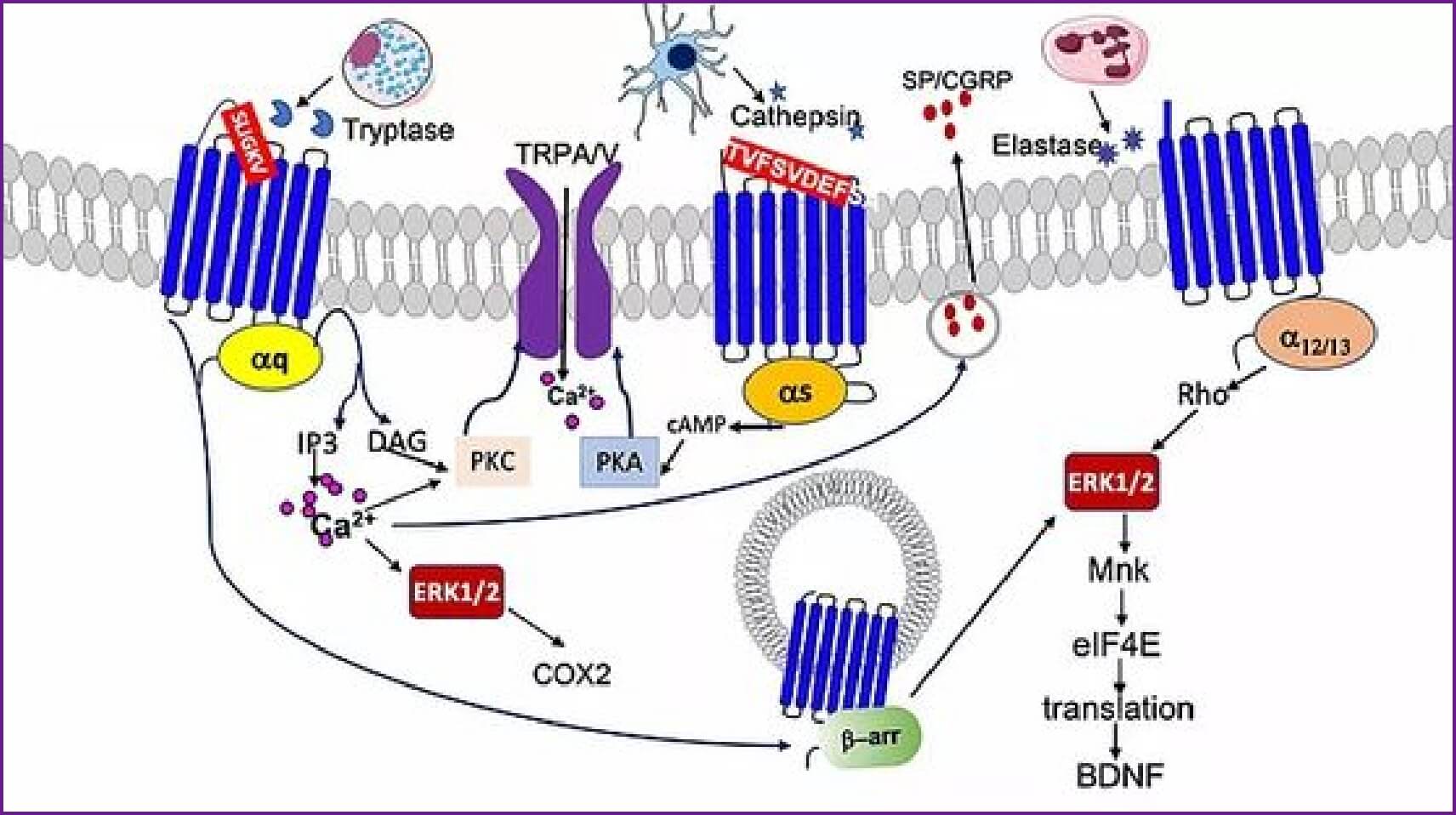
Trypsin-like proteases and Cathepsin-S lead to activation of two serine/threonine kinases (PKA and PKC) that phosphorylate ion channels in neurons called Transient Receptor Potential (TRP) channels in peripheral nerve terminals of pain sensing neurons. When they are activated, TRP channels in allow the influx of Calcium, which changes the electrical potential across the neuronal membrane leading to transmission of the pain signal to the central nervous system. When phosphorylated by PKC and PKA, TRP channels are more easily activated. In this way PAR-2 activation lowers the threshold needed to transmit a signal and enhances pain sensation. Transient Receptor Potential (TRP) channels In these same nerve terminals, trypsin-like proteases promote calcium-dependent release of neurotransmitters such as CGRP and SP from preformed secretory vesicles.
Trypsin-like proteases and elastase promote activation of Extracellular Regulated Kinases 1 and 2 (ERK1/2) via 3 different pathways: Gq-dependent, arrestin-dependent, and Rho-dependent. ERK1/2 can phosphorylate MNK1/2 in the cytosol, to promote protein translation and it can phosphorylate nuclear targets, such as the transcription factor AP-1, to promote gene expression. One of the genes expressed in response to Gq-dependent ERK1/2 activation is Cyclooxygenase 2 (COX2), that then catalyzes the production of prostaglandin E2 (PGE2). PGE2 is a major mediator of inflammation and pain, and COX2 is the enzyme that many nonsteroidal anti-inflammatory drugs (NSAIDS), such as ibuprofen, inhibit.

Highly targeted and highly effective.

Trypsin-like proteases and Cathepsin-S lead to activation of two serine/threonine kinases (PKA and PKC) that phosphorylate ion channels in neurons called Transient Receptor Potential (TRP) channels in peripheral nerve terminals of pain sensing neurons. When they are activated, TRP channels in allow the influx of Calcium, which changes the electrical potential across the neuronal membrane leading to transmission of the pain signal to the central nervous system. When phosphorylated by PKC and PKA, TRP channels are more easily activated. In this way PAR-2 activation lowers the threshold needed to transmit a signal and enhances pain sensation. In these same nerve terminals, trypsin-like proteases promote calcium-dependent release of neurotransmitters such as CGRP and SP from preformed secretory vesicles.

Trypsin-like proteases and elastase promote activation of Extracellular Regulated Kinases 1 and 2 (ERK1/2) via 3 different pathways: Gq-dependent, arrestin-dependent, and Rho-dependent. ERK1/2 can phosphorylate MNK1/2 in the cytosol, to promote protein translation and it can phosphorylate nuclear targets, such as the transcription factor AP-1, to promote gene expression. One of the genes expressed in response to Gq-dependent ERK1/2 activation is Cyclooxygenase 2 (COX2), that then catalyzes the production of prostaglandin E2 (PGE2). PGE2 is a major mediator of inflammation and pain, and COX2 is the enzyme that many nonsteroidal anti-inflammatory drugs (NSAIDS), such as ibuprofen, inhibit.

Chronic Pain

Interested in learning more about our technology to treat chronic disease?

Investors Resources
Subscribe